Personal Site Field Notes
A live demonstration post covering TOC, figures, notes, and reciprocal wiki links in the public writing pipeline.
Contents
This post is the main live demonstration for the writing system. It exists to prove that the public site can carry a proper note-driven article with tags, images, a real table of contents, and reciprocal wiki links without falling back into a heavy CMS workflow.1 It also gives the archive a real published entry instead of a blank state.
The short version is simple: the site should behave like a calm front end for a larger body of work. Writing sits beside projects, not under them. Search should feel immediate. Notes should support scholarly prose without turning the page into an over-designed research toy.2
Categories and links
For now, tags are doing the work of categories. That is enough for the first release because it keeps the content model flat and easy to maintain. A post can live under Notes, Personal Site, and Digital Humanities at the same time, and the tag archive can still give the reader a useful way back into the corpus.
The other useful test is internal structure. This page now points to a companion link note, and that note points back here. That gives the public site a real forward-link and backlink pair instead of a synthetic graph example.
Why two posts matter
If there were only one public note, the backlink section would have nothing to display. The second post exists precisely so that this page can demonstrate the loop: inline reference outward, backlink homeward, and both pages participating in the same file-first graph.
Figure
One rule seems worth keeping: article-specific images should stay close to the article, not be scattered across public/. In Astro, the cleanest version of that is to colocate the image asset with the post and import it directly into MDX.
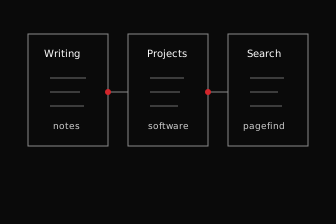
Fig. 1. A simple site map for the current personal-site structure, with writing, projects, and search treated as related but distinct surfaces.3
That keeps the asset story readable:
- The article owns its own figure.
- The file survives refactors because the import is explicit.
- The post can later grow into multiple figures without polluting the top-level static asset space.
What the figure is proving
The figure is intentionally plain. Its job is not visual persuasion. Its job is to prove that article-local assets, captions, and note references can live together without introducing a separate media-management system.3
Notes and references
There are really two note behaviors being tested here.
First, ordinary footnotes should remain part of the prose rhythm.4 On wide screens they can live in the margin. On smaller screens they should fall back into the text flow without breaking the reading order.
Second, some material belongs better in a more conventional notes section. Instead of forcing every long citation into the margin, this post uses a small endnotes block below for references that are more bibliographic than argumentative.
Linking as annotation
The link to companion-link-note is doing something slightly different from an ordinary footnote. It is not a local clarification. It is an explicit path into a second note that can answer back. That makes the forward-link and backlink pair feel closer to scholarly cross-reference than to blog navigation.
Endnotes
- Astro documentation, MDX integration guide.
- Astro documentation, content collections guide.
- Pagefind documentation on static-site search.
Closing
The point of this sample is not its argument. The point is that the whole pipeline now has a real public object passing through it: tags, page generation, RSS, search, OG, an image import, and note-heavy text all at once.